GovernView
A governance audit tool for Microsoft Fabric. It reads the metadata of your workspaces, reports what is wrong and how serious it is, and generates the notebooks to put it right. Every check is deterministic: the same workspace state always produces the same findings.
What it checks.
Eighteen checks across four areas. Each one is a rule written in code and applied the same way every time. Nothing is inferred by a language model, so no finding can be invented and every finding can be traced to the rule that produced it.
Access and accountability
Five checks on who holds Admin. Workspaces with no admin at all, workspaces with only one, admin principals nobody can identify, and automated service principals holding full control of production.
Documentation and structure
Seven checks on what your estate looks like to someone who did not build it. Missing descriptions, staging artefacts left in production, duplicate semantic models, mixed naming conventions, and lakehouses that are empty or full of pipeline residue.
Data protection
Three checks on exposure. Items named as if they hold sensitive data, items carrying no Purview sensitivity label, and workspaces with no managed private endpoint confining data movement to a private path.
Capacity and reliability
Three checks on what your refreshes cost you. Semantic models all refreshing in the same window, failure rates above your threshold, and a per-model health profile covering duration, frequency and failures.
How it works.
A scan runs against up to twenty workspaces at a time and takes minutes, not days.
GovernView reads workspace metadata through the Fabric and Power BI REST APIs. It never reads the data inside your tables, datasets or reports. Every finding comes from item names, types, descriptions, permissions, refresh history and lakehouse table names. The scanning identity needs the Member role on each workspace you want covered and holds read permissions only, so a scan cannot change anything in your environment.
You choose the scope: eight checks covering security and accountability, ten covering structure and hygiene, or all eighteen. The output is a PDF report that opens with the business risk in plain language, then lists every finding by severity with the items affected and numbered steps to remediate it. A full single-workspace report runs to about twenty pages.
Findings are also a starting point for fixing things. You decide item by item what should happen, and GovernView generates a Fabric notebook that carries out those decisions through the Fabric API. Twelve of the eighteen checks support this; the other six are guidance only, because the fix belongs in a place a notebook should not reach. You run the notebook under your own identity, and anything destructive asks for confirmation first.
On where your metadata goes, plainly: GovernView currently runs as a container in my own Azure subscription, behind Entra ID sign-in, which means scanned metadata leaves your tenant. The same container is built to run inside a customer tenant instead, and that is how an enterprise deployment would work. It has not been set up for anyone yet.
Seeing it run.
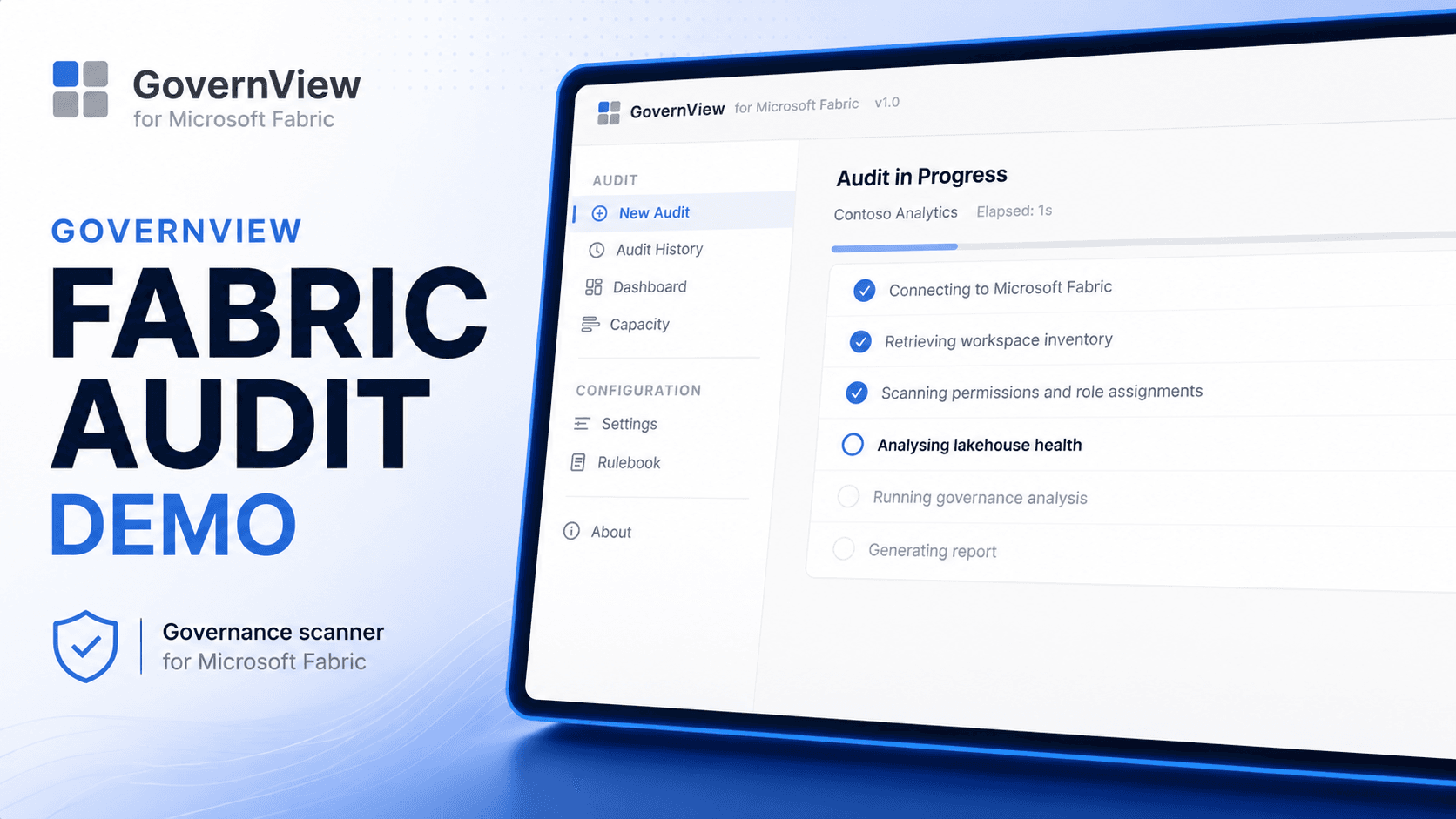
I presented GovernView at the Fabric User Group Switzerland in July 2026. The recording below is a conference talk and not a product walkthrough, so the demo starts around 38 minutes in.
Where this stands.
GovernView works and is in active development. It is not a finished product. It has run against my own Fabric tenant and a demo environment built to contain the problems it looks for. It has not been run against a customer's production tenant, it is not for sale, and there is no download or trial. I run it myself.
Next on the list: a way to mark a finding as intentional so it stops being raised, workspace standardisation notebooks, and running as a native workload inside the Fabric portal. None of that is built yet.
Governance problems are easier to fix early.
If your Fabric estate has grown faster than the rules around it, a conversation costs nothing. I can walk you through what GovernView looks for and what a governance review would involve.